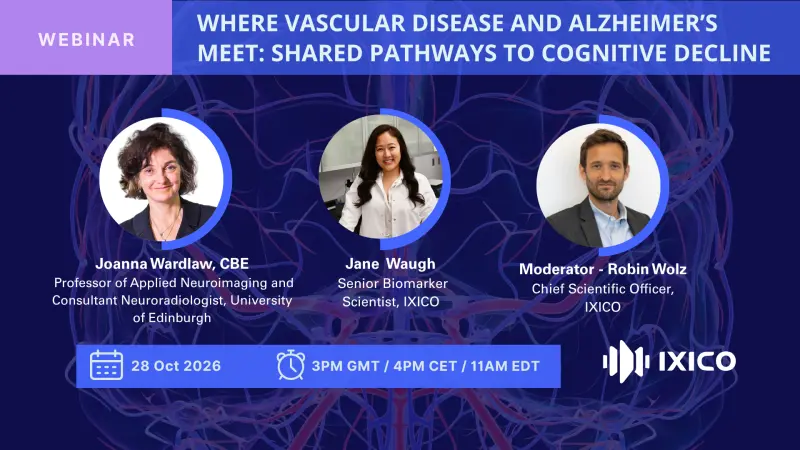
Join us for our latest webinar, where we explore why vascular brain injury matters in cognitive decline and Alzheimer’s disease, and how imaging can help reveal its role in clinical research. Prof Joanna Wardlaw, an internationally recognised expert in cerebral small vessel disease, stroke, brain ageing, and neuroimaging, will explain how vascular imaging features such as white matter hyperintensities, infarcts, cerebral microbleeds, lacunes, enlarged perivascular spaces, and brain atrophy relate to cognitive outcomes and can be assessed pragmatically in busy clinical or research settings. Jane Waugh, PhD will then examine the vascular biomarkers most relevant to Alzheimer’s disease clinical trials and how they inform eligibility, safety monitoring, prognosis, and disease characterization.
Session 1: Cerebrovascular Contribution to Cognitive Impairment: From Cerebral Small Vessel Disease to Mixed Dementia
Prof Joanna Wardlaw, a leading authority in cerebral small vessel disease, stroke, brain ageing, and neuroimaging, will explain why vascular brain injury matters in cognitive decline and how key cerebrovascular imaging features, including white matter hyperintensities, focal lesions and infarcts, enlarged perivascular spaces, cerebral microbleeds, lacunes, and brain atrophy, relate to future cognitive outcomes. She will discuss their relevance to Alzheimer’s disease and memory-clinic populations, where cerebrovascular and neurodegenerative pathologies frequently coexist, and show how visual assessments, such as grading white matter disease severity or recording a small vessel disease score, can provide practical insight when time for centralized image analysis is limited. Drawing on evidence from large-scale studies, she will demonstrate that vascular imaging assessment can be straightforward, standardized, and clinically meaningful, offering a pragmatic framework for incorporating these features into busy clinical or research settings.
Session 2: Cerebrovascular Imaging Biomarkers in Alzheimer’s Disease: What They Measure and Why They Matter
Jane Waugh, PhD will build on Prof Wardlaw’s overview by explaining the vascular imaging biomarkers most relevant to Alzheimer’s disease clinical trials, including white matter hyperintensities, cerebral microbleeds, lacunes, infarcts, cortical superficial siderosis, enlarged perivascular spaces, and emerging markers of vascular dysfunction. For each biomarker, she will define what it measures, explain how commonly it is observed in Alzheimer’s disease populations, describe its relationship to vascular and Alzheimer’s disease pathology, and outline its role in clinical trials, from eligibility and safety monitoring to outcome assessment. She will also cover the practical requirements for assessment, including the MRI sequences needed, how these fit within standard imaging protocols, and the additional scan time involved, giving a clear view of how established and emerging vascular biomarkers can inform disease heterogeneity, prognosis, and safety risk.
What you’ll learn:
-
Why vascular brain injury matters in cognitive decline and Alzheimer’s disease, including how vascular and neurodegenerative pathologies can coexist and influence disease progression.
-
How to recognize key vascular imaging biomarkers, including white matter hyperintensities, cerebral microbleeds, lacunes, infarcts, cortical superficial siderosis, and enlarged perivascular spaces.
-
What these biomarkers reveal about prognosis and underlying pathology
-
How vascular imaging can support Alzheimer’s disease clinical trials, from patient stratification to treatment-safety monitoring, ARIA-risk assessment, and interpretation of clinical outcomes.
About the speakers and moderator
Professor Joanna Wardlaw, CBE, MB ChB (Hons), MD, FRCR, FRCP, FMedSci, FRSE
Jane Waugh, Senior Biomarker Scientist – IXICO
Moderator: Robin Wolz, CSO/CMO - IXICO
Robin Wolz has over 15 years' experience in the development of innovative analytics solutions in healthcare with a focus on imaging technology. Prior to IXICO, Robin held different roles at Philips in the Research and Diagnostic X-Ray divisions. Robin holds a PhD in medical imaging and computer science from Imperial College London, focused on early detection of Alzheimer's disease. He is the co-author of more than 100 publications and holds multiple patents in the field of medical imaging and AI data analytics.