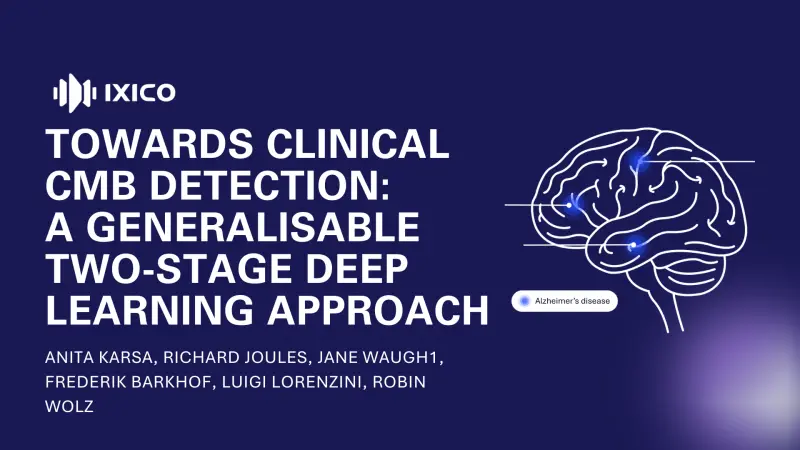
Cerebral microbleeds (CMBs) provide an important eligibility and safety measure in Alzheimer’s disease (AD) drug development, particularly as anti-amyloid therapies require close monitoring for treatment-related ARIA-H. Radiologists currently assess CMBs manually, which can be labour-intensive and subject to inter-observer variability. AI-based tools could support radiologists in this process, helping to speed up monitoring, standardise reads across sites and meet the growing demands of AD clinical trials and the wider rollout of AD therapies.
This study developed a two-stage deep learning pipeline to support CMB detection on MRI. The first stage identifies potential microbleeds across the whole brain, while a second AI model analyses each candidate in more detail to distinguish true CMBs from similar-looking structures. Researchers evaluated the pipeline using 60 unseen, radiologist-labelled scans from the ADNI and EPAD studies. The pipeline achieved a mean subject-level sensitivity of around 90% at one false positive per subject and performed consistently across T2* and SWI magnitude imaging.
The findings demonstrate the potential for AI-assisted detection to support faster and more standardised CMB assessment across studies and imaging sequences, while allowing radiologists to focus their review on uncertain cases. This approach could help address the increasing safety-monitoring demands associated with Alzheimer’s disease clinical trials and anti-amyloid therapies.