

Accurate measurement of brain volume loss due to the loss of brain cells (brain atrophy) on magnetic resonance imaging (MRI) is fundamental to developing new treatments for Huntington’s disease (HD).
Traditionally, researchers have relied on the Boundary Shift Integral (BSI)—a labour intensive semi-manual “gold standard” that requires expert delineation of brain regions on MRIs. Due to the time and resource burden of this method, BSI is operationally more complex to scale across large, multisite trials.
At HDTC 2026, IXICO presented new data demonstrating that automated capabilities to measure brain atrophy on MRI within its IXI™ Platform can match, and even exceed, the performance of the semi-manual BSI method providing advanced, cost-effective and scalable solutions to support clinical trials in HD.
What Was Compared
The study evaluated three approaches:
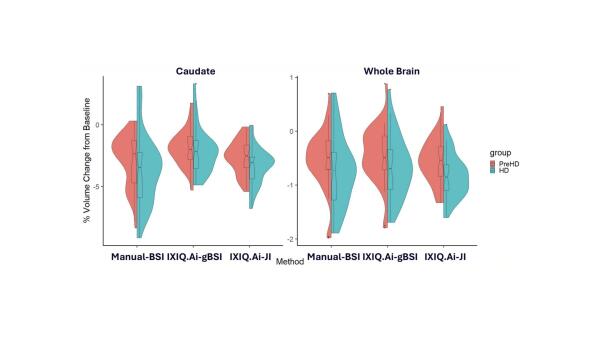
- Manual segmentation + BSI (current best practice)
- IXI Platform: automated segmentation + generalised BSI (gBSI)
- IXI Platform: automated segmentation + deep learning Jacobian Integration
Key Findings
- Of the three approaches the IXI Platform delivered the highest sensitivity for detecting whole brain and caudate volume loss—making it the most sensitive method tested.
- The automated gBSI capability performed comparably to semi-manual BSI, showing that automation can preserve scientific rigour.
Why This Matters
The results demonstrate that the IXI™ Platform delivers sensitive automated neuroimaging analytics that are more sensitive in measuring brain volume loss on MRI when compared to the current gold standard. By using a scalable, sensitive AI imaging analysis approach, researchers can reduce the operational burden of manual MRI analysis and increase sensitivity to detecting changes in the brain.
IXICO’s IXI Platform offers validated technology that supports faster, accurate and more efficient imaging analytics to support therapeutic development.